
FREESanctions, PEP & AML/CFT screening database. Search any name.
← All industries
Life · General · Health & HMO · MotorOmniguard claims fraud · Application Shield · Blue3 min read

Security for Insurers & Health Insurance

Cut claims fraud and protect member data, on one entity graph, from a single agent.

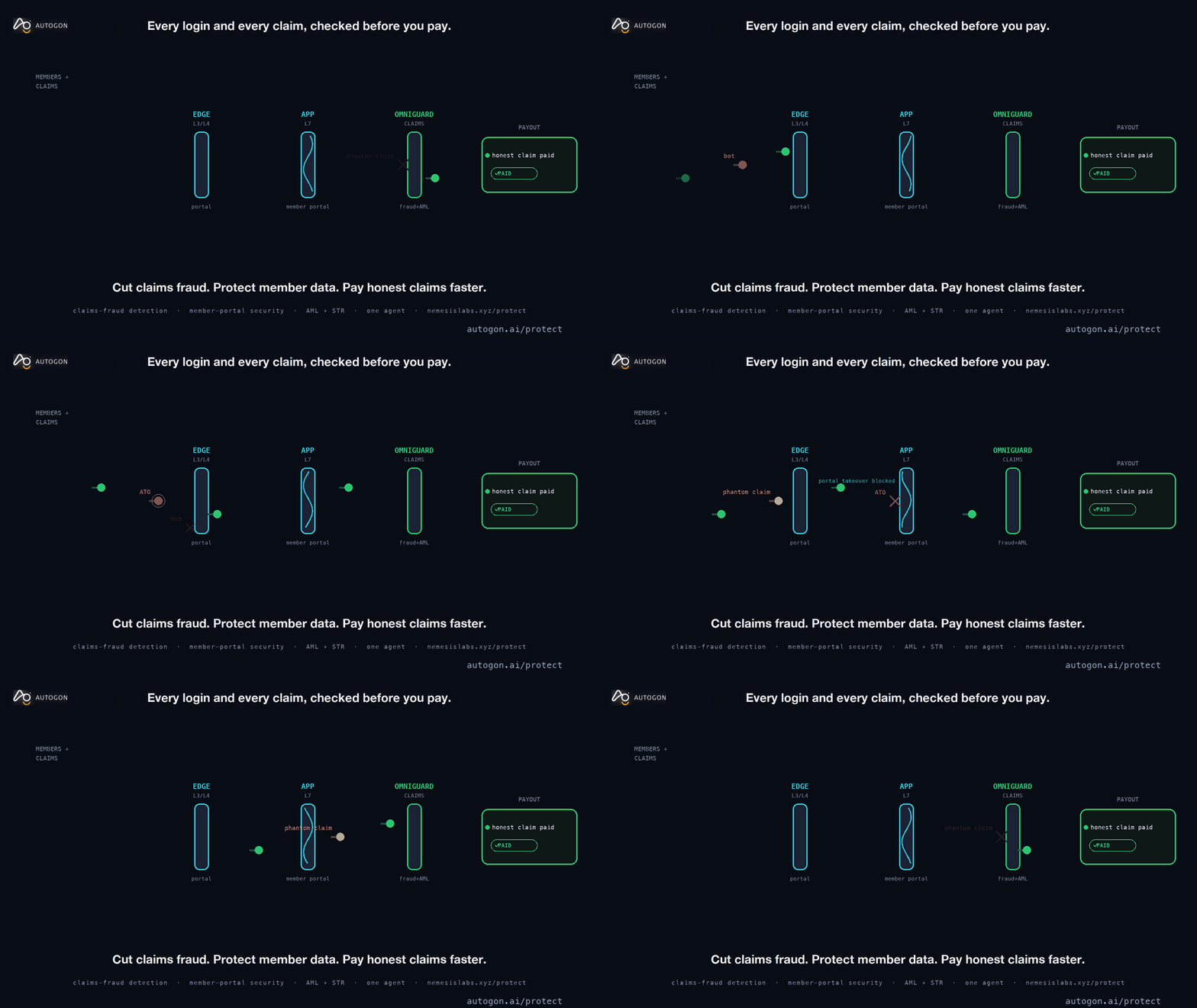
How Nemesis protects Security for Insurers & Health Insurance in one pass
Live flow: attacks stopped at each layer, your real users served.

An insurer loses money two ways. Out the front, as fraudulent claims. Out the back, as a breached member record. Nemesis closes both leaks from one agent, on a shared view of every member and provider.

The two leaks

  • Claims out the door. Across the market, roughly a quarter of claims are fraudulent, wasteful or abusive: phantom and ghost-patient billing, ghost enrollees, upcoding, duplicate and inflated claims, and provider-member collusion. Insurance fraud costs hundreds of billions a year globally.
  • Data out the back. Health and insurance records are the most valuable data on the dark web and the costliest to breach, year after year. Ransomware has exposed hundreds of millions of members, and member portals are drained by account takeover and API abuse.

The connection you can exploit: the same fraud ring that takes over a member's portal login also files the fraudulent claim behind it. When the fraud engine and the security layer are the same system, you catch both.

What Nemesis does

One agent, three capabilities on one entity graph:

  • Omniguard scores every claim for phantom billing, ghost enrollees, upcoding, duplicates and provider collusion, and covers sanctions screening and STR filing for your life book.
  • Application Shield protects your member and provider portals, mobile apps and claims APIs from account takeover, API abuse and zero-days, so the breach never happens.
  • Blue defends the servers and staff endpoints that hold member records against ransomware and insider theft.

It works alongside your existing claims platform, not against it.

The number your Head of Claims already knows

Claims fraud is the textbook machine-learning problem: high volume, repeating patterns, a clear right answer. If a fifth of premiums leak to fraud, waste and abuse, then even a modest recovery is a direct, measurable addition to the bottom line, the easiest business case in the building to prove.

Getting started

Start with a 30-day pilot over a sample of your own claims, observe-only. We show you how much fraud is in them, and what is hitting your portals, before you commit.

Integrate Nemesis

Plug Nemesis into your stack

One agent runs all three. Start with whichever you need. Most begin with Omniguard for the money, add Application Security for the apps behind it, and Edge to keep it all standing.

See it working - live demo

A real, working app for this sector, deployed twice: one build protected by Nemesis end to end, one left unprotected. Run the same attacks on both - fraud, injection, account takeover, BOLA and mule cash-outs - and watch the protected build block what the other lets through. It opens a guided walkthrough so you can run the end-to-end tests yourself.

Screen every payout beneficiary and score every claim before the money leaves. Inflated and fabricated claims, sanctioned or PEP beneficiaries and policyholder identity fraud, caught before payment, on the claims system you already run.

Free to start

Screen every payout beneficiary against sanctions and PEP lists, free, before you release a claim. 100 screens a day, no card, no function to build. Search it now or wire the API, then grow into full transaction scoring when you are ready.

POST https://shield.nemesislabs.xyz/api/v1/omniguard/verify   { "check":"sanctions_pep", "subject":"…" }   # free · no function needed
1 Who are you?

You build the product and own the payment code end to end.

Your access to transactions

Full code control - insert Omniguard inline on the payment path.

Recommended: Inline API / SDK
What you are fighting
Card testing & BIN attacksMule & payout fraudChargeback / first-party fraudAccount takeoverStructuring & scam payoutsSanctions & PEP screening
CBN / NFIU obligations Omniguard covers for you
Real-time monitoringSanctions & PEP screeningSTR to the NFIU (goAML)KYC/CDD (BVN/NIN)PCI-DSS for card dataPSP / switch licensing conditions
2 How do you reach your transactions?

Inline API / SDK

You call Omniguard from your payment, transfer or checkout path, before you post the entry. The verdict comes back in one request; you block, hold or allow.

LatencyReal time · sub-second
EnforcementDecline before the transaction commits
Best forFintechs, PSPs, wallets, e-commerce and digital-first banks - anyone who controls their own transaction code.
1

Create a function, get your key

A function is region × app × event (e.g. NG × payments × transfer). Create it in the Omniguard console, or via the API with your developer key. You get a function id and an ingest token (your API key). Sector rules are seeded automatically.

curl https://shield.nemesislabs.xyz/api/v1/omniguard/functions \
  -H "authorization: Bearer $DEV_KEY" \
  -H "content-type: application/json" \
  -d '{"name":"NG payments","industry":"banking","event":"transfer","region":"NG"}'
# → { "functionId":"fn_…", "ingestToken":"og_…", "rulesSeeded":16 }
2

Score every transaction before it commits

Send the transaction to /score on the payment path. Include what you have; Omniguard enriches the rest (BIN, first-time-payee, velocity, graph, breach). Any custom field you add is scored too.

curl https://shield.nemesislabs.xyz/api/v1/omniguard/score \
  -H "authorization: Bearer $OMNIGUARD_KEY" -H "content-type: application/json" \
  -d '{"function_id":"fn_…","customer_ref":"cust_913","amount":1500000,
       "currency":"NGN","channel":"web","country":"NG",
       "counterparty_account":"0123456789","beneficiary_name":"A. Bello"}'
# → { "verdict":"block", "overall_score":97, "rule_score":97, "ai_score":null,
#     "reasons":[{"signal":"Beneficiary is a flagged mule","contribution":55}],
#     "transaction_id":"txn_…", "ctr":{"reportable":false} }
3

Act on the verdict

block → decline. review → hold or step-up (OTP, call-back). allow → proceed. Test everything with dry_run:true first (free, persists nothing).

if (r.verdict === "block")  decline(txn);
else if (r.verdict === "review") holdForReview(txn);
else                            proceed(txn);
4

Screen the parties

One call, no function needed. Screen a name against sanctions/PEP, or verify identity (BVN/NIN/passport). Screening is free; KYC is metered.

curl https://shield.nemesislabs.xyz/api/v1/omniguard/verify -H "authorization: Bearer $OMNIGUARD_KEY" \
  -d '{"check":"sanctions_pep","subject":"Ibrahim Musa"}'
# → { "risk":"hit", "data":{"lists":["OFAC (US)"]}, "usage":{…} }
5

Enforce, learn, report

Flip the function to enforce so block is binding. Send true outcomes back to sharpen the model, and file goAML STR/CTR from the case.

curl https://shield.nemesislabs.xyz/api/v1/omniguard/outcome -d '{"transaction_id":"txn_…","outcome":"fraud"}'
# STR for the NFIU:  GET https://shield.nemesislabs.xyz/api/v1/omniguard/reports/{id}/goaml  (goAML XML)

The whole flow in four calls

# 1 · create a function → get your key (or do it in the console)
POST https://shield.nemesislabs.xyz/api/v1/omniguard/functions   { "name":"…", "industry":"…", "event":"…" }
# 2 · score a transaction before it commits
POST https://shield.nemesislabs.xyz/api/v1/omniguard/score       { "function_id":"fn_…", "amount":…, "counterparty_account":"…" }
                         → { "verdict":"block", "overall_score":97, "reasons":[…], "transaction_id":"…" }
# 3 · screen a party (no function needed, screening is free)
POST https://shield.nemesislabs.xyz/api/v1/omniguard/verify      { "check":"sanctions_pep", "subject":"…" }
# 4 · report the outcome + file the STR
POST https://shield.nemesislabs.xyz/api/v1/omniguard/outcome     { "transaction_id":"…", "outcome":"fraud" }
GET  https://shield.nemesislabs.xyz/api/v1/omniguard/reports/{id}/goaml   → goAML STR XML for the NFIU
Vibe-code it - Nemesis MCP

Wire all of this from your AI coding agent. Add the Nemesis MCP server to Claude, Cursor, Windsurf or VS Code, then just ask - the agent calls the real tools (create a function, score a transaction, screen a name, protect the app) and ships it for you. Sanctions and PEP screening is free.

1 · Add the server
{
  "mcpServers": {
    "nemesis": {
      "command": "npx",
      "args": ["-y", "@nemesis-shield-autogon/mcp"],
      "env": { "NEMESIS_API_KEY": "nsk_your_key" }
    }
  }
}
Or one command: npx -y @nemesis-shield-autogon/mcp
2 · Ask your agent
Add Nemesis to my claims system: create an Omniguard function for insurance claims, score each claim for fraud, screen every payout beneficiary against sanctions and PEP lists before release, and protect the claims portal.
Would rather we set it up with you?

Not every team wants to wire this in themselves. Tell us your setup and our engineers will map the integration to your stack and walk you through it end to end, from first call to enforce.

Contact us for hands-on help →